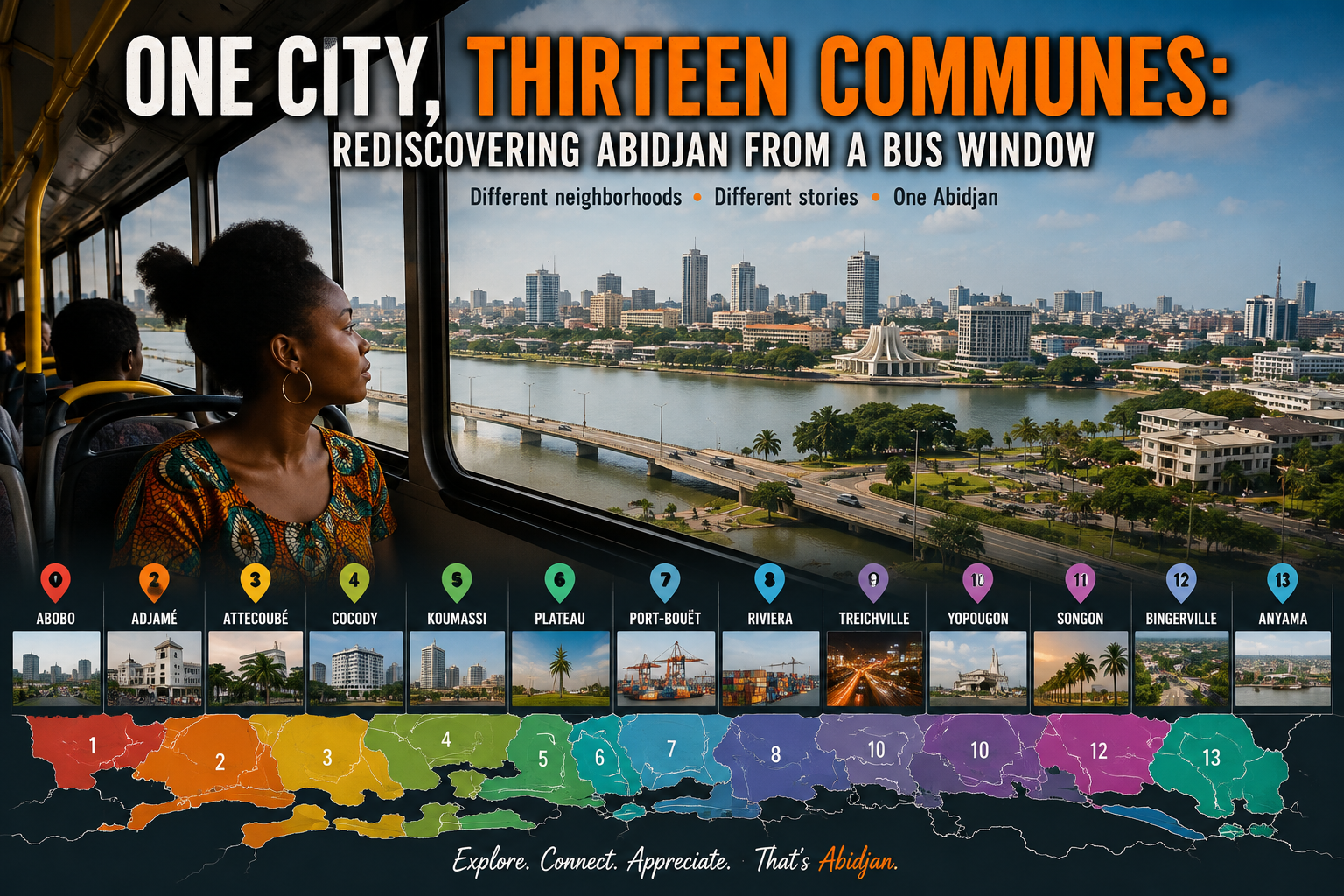
One City, Thirteen Communes: Rediscovering Abidjan From a Bus Window
A look at the 13-commune route of The Moving Circle's First Journey, and why seeing Abidjan from a bus, together with strangers, changes how you see your own city.
Ask anyone who has lived in Abidjan for more than a few years what the city looks like, and they will usually describe the version they know best — their commune, their route to work, the handful of streets between home and everywhere they actually go. Cocody looks like Cocody. Yopougon looks like Yopougon. Most of us experience our own city in a straight, well-worn line, repeated so often it stops registering as a place at all.
The Moving Circle's First Journey is built to break that line. On Saturday, 26 September 2026, one bus carrying strangers who are about to stop being strangers will move through thirteen communes in a single day — Songon, Anyama, Abobo, Adjamé, Attécoubé, Yopougon, Plateau, Treichville, Marcory, Koumassi, Port-Bouët, Cocody and Bingerville — stitching together a city that most of its own residents rarely see in full.
A City Most People Only See in Fragments
Greater Abidjan is enormous, diverse, and layered in ways a daily commute simply does not reveal. The energy of Yopougon on a Saturday afternoon is different from the quiet of Bingerville's tree-lined roads. The commercial rush of Adjamé moves at a different rhythm than the coastal calm of Port-Bouët. Most people know two or three of these communes well and the rest only by name, by reputation, or by whatever a taxi driver once told them.
That is precisely the gap The Moving Circle is designed to close. This is not a sightseeing tour with a guide reciting facts through a microphone. It is a full-day, city-wide experience where the journey itself — the changing streets, the shifting energy outside the window, the conversations happening inside the bus — becomes the event.
This isn't just a bus ride. The journey itself is the event.
Why Seeing Your City Differently Changes You
There is something quietly powerful about moving through a familiar place with unfamiliar eyes. When you are not driving, not checking a map for directions, not rushing toward a destination, you start to notice things you have driven past a hundred times without ever really looking at. The color of a market awning. The way afternoon light falls differently in Attécoubé than it does in Marcory. The small architectural details that disappear when a street is just something you pass through on the way to somewhere else.
People who study travel and novelty often point out that you do not need to leave your country — or even your city — to get the mental refresh that comes from new surroundings. What matters more than distance is attention. A day spent deliberately noticing a place you thought you already knew can produce a version of the same discovery people travel abroad to chase.
For the people on this particular bus, that discovery will not happen alone. It will happen shoulder to shoulder with entrepreneurs, creatives, students, professionals and travelers who are seeing the same streets for the first time — or seeing them properly for the first time — together, at the same moment, from the same window.
What the Route Says About the Mission
The choice to move through thirteen communes rather than stay in one part of the city is not incidental. It reflects what The Moving Circle is trying to build: a community that does not belong to one neighborhood, one social circle, or one professional bubble. Songon and Plateau are not usually mentioned in the same breath. On 26 September 2026, they will be part of the same story, connected by the same bus, the same day, and the same group of people learning each other's names.
Along the way, the day is built around a few simple ideas:
- Storytelling. Passengers get the chance to share experiences, lessons and memorable moments on the mic — no polished speech required, just real stories, told out loud.
- Music and entertainment. A DJ set moving through Afrobeats, Amapiano and Afropop keeps the energy alive between conversations, alongside a comedy segment built for shared laughter among people who were strangers an hour earlier.
- Networking. Entrepreneurs, creatives and professionals are seated among people they would likely never cross paths with in their usual routine — a different kind of room than any conference hall.
- Content creation. With thirteen communes' worth of backdrops in a single day, there is no shortage of material for anyone documenting the journey as it happens.
A Day Built for People Who Are Curious About Their Own City
You do not need to be a visitor to rediscover a place. Sometimes the people most likely to fall back in love with Abidjan are the ones who have lived there the longest — the ones who stopped noticing it because it became background noise to daily life. The Moving Circle is, in part, an invitation to look up again: at the streets, at the skyline, at the strangers sitting two rows over who might turn into the most interesting person you talk to all month.
This is the First Edition of an idea The Moving Circle hopes will grow into something bigger — a recurring reason for people across Greater Abidjan, and eventually beyond, to move through their city together instead of past each other, day after day, in separate cars and separate routines.
Book Your Seat on the Route
The bus departs at 09:00 on Saturday, 26 September 2026, with only 31 seats available for THE MOVING CIRCLE: THE FIRST JOURNEY, priced at 10 000 FCFA per person. Whether you have lived in Abidjan your whole life or you are new to the city, this is a chance to see it — and the people in it — differently, for one full day.
Come alone. Come with friends. Come with your circle. Thirteen communes, one bus, one unforgettable day. Secure your seat before the journey fills up.